Products
SentimenTrader Trading Tools
‍
Backtest Engine
My Trading Toolkit
Correlation Analysis
Seasonality
Market Prediction
Indicators & Data API
‍
Proprietary Indicators & Charts
Market Data API
Strategies & Scanner
‍
50+ Trading Strategies
Smart Stock Scanner
Smart Option Scanner
Research Reports
‍
Research Solutions
Reports Library
Free Resources
Simple Backtest Calculator
Simple Seasonality Calculator
The Kelly Criterion Calculator
Sentiment Geo Map
Public Research Reports
Education
Sentiment Indicators
Technical Indicators
Pricing
Company
About
In the News
Testimonials
Client Success Stories
Contact
Log inLoginSign up
< BACK TO ALL REPORTS

Inflation is shifting to unfavorable for stocks

Jay Kaeppel
2026-06-11
The market environment just changed somewhat, and not for the better. Rising inflation causes great uncertainty, and the stock market hates uncertainty. PPI and CPI figures are now officially in "unfavorable" territory. Does this mean stocks are doomed? Not necessarily. But the odds have shifted. Details herein.

Key points:

  • The stock market hates uncertainty, and few things cause more uncertainty than rising inflation
  • Both the Producer Price Index and Consumer Price Index are now outside of their "normal inflation" range
  • While inflation is only one factor that affects stock prices, this is an unfavorable development for stock investors

The current state of the Producer Price Index

The Producer Price Index (PPI) is a measure from the Bureau of Labor Statistics (BLS) that tracks the average change over time in selling prices received by domestic producers for their output. It acts as a key indicator of wholesale inflation.

Note that the PPI data is typically updated mid-month. However, for testing purposes, all analysis below assumes we update only at the end of each month.

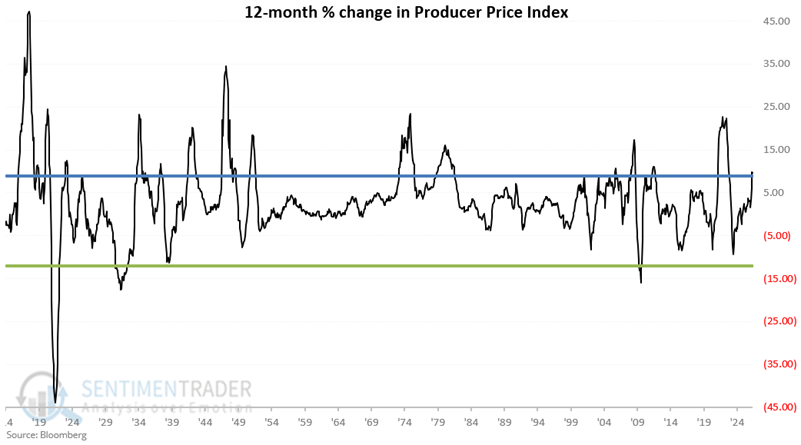
The real question regarding PPI is the annual rate of change, i.e., how quickly prices are rising or falling. We look at the 12-month percentage rate of change as a measure of wholesale inflation. The chart below shows the 12-month % change for PPI since 1914. The horizontal lines represent the +9% and -12% cutoffs.

  • Readings between +9% and -12% are considered "normal" PPI inflation
  • Readings of +9% or higher are considered "too much PPI inflation"
  • Readings of -12% or lower are considered "too much PPI de

Sorry, you don't have access to this report

Upgrade your subscription plan to get access
Go to Dasboard
PRODUCTS
SentimenTrader
Trading Tools
Indicators & Data API
‍
Strategies & Scanner
‍
Research Reports
FREE
RESOUrCES
Simple Backtest
Calculator
Simple Seasonality
Calculator
The Kelly Criterion
Calculator
Sentiment Geo Map
‍
Public Research Reports
‍
Education
Sentiment Indicators
‍
Technical Indicators
‍
Pricing
Bundle pricing
‍
FAQ
‍
Announcements
‍
COMPANY
‍
About
‍
In the News
‍
Testimonials
‍
Client Success Stories
CONTACT
‍
General Inquiries
‍
Media Inquiries
‍
Financial Professionals Inquiries
‍
© 2026 Sundial Capital Research Inc. All rights reserved.
Setsail Marketing
TermsPrivacyAffiliate Program
Risk Disclosure: The information and tools provided are for research and analytical purposes only and are not intended as investment advice. Market analysis involves uncertainty, and outcomes may differ from expectations. Users should conduct their own due diligence and consider their individual circumstances before making any financial decisions. Past performance is not necessarily indicative of future results.

Hypothetical Performance Disclosure: Hypothetical performance results have many inherent limitations, some of which are described below. No representation is being made that any account will or is likely to achieve profits or losses similar to those shown; in fact, there are frequently sharp differences between hypothetical performance results and the actual results subsequently achieved by any particular trading program. One of the limitations of hypothetical performance results is that they are generally prepared with the benefit of hindsight. In addition, hypothetical trading does not involve financial risk, and no hypothetical trading record can completely account for the impact of financial risk of actual trading. for example, the ability to withstand losses or to adhere to a particular trading program in spite of trading losses are material points which can also adversely affect actual trading results. There are numerous other factors related to the markets in general or to the implementation of any specific trading program which cannot be fully accounted for in the preparation of hypothetical performance results and all which can adversely affect trading results.

Testimonial Disclosure: Testimonials appearing on this website may not be representative of other clients or customers and is not a guarantee of future performance or success.